Mon - Fri: 9:00 - 19:00
 EN

Mon - Fri: 9:00 - 19:00
When you buy a BSD system, the spec sheet is only the surface. The question you actually need answered is simpler: is this money well spent?
I have spent more than twenty years in commercial vehicle safety systems, and I have sat in a lot of fleet managers' offices. The questions they ask come back to these nine, again and again.
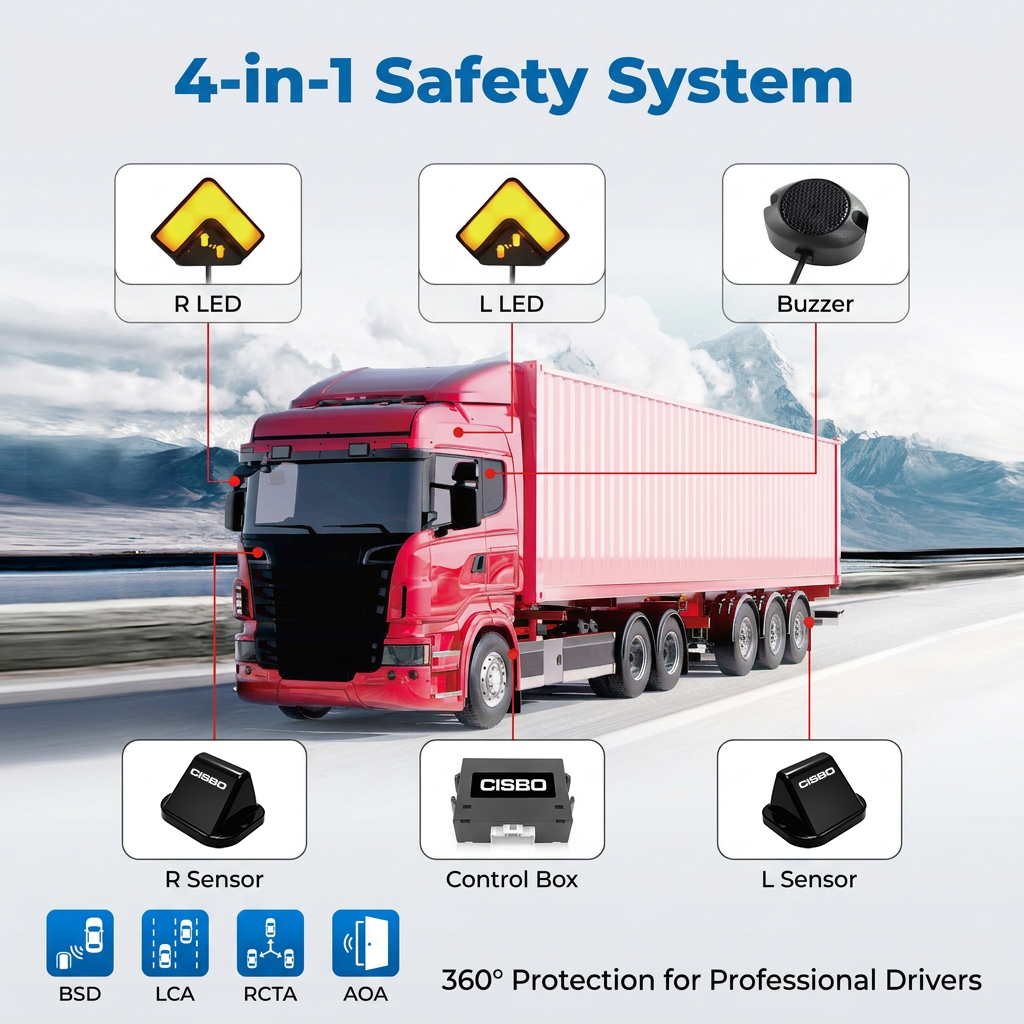
The repair bill is only the part of a blind-spot accident that shows above the water. Downtime, premium increases, and legal costs are typically 3–5× the repair cost.
BSD warns before the collision happens. What it really does is convert "pay after the fact" into "warn before the fact" — what you reduce is not the repair cost, but the invisible knock-on losses.
How much it drops depends on three things: how high your fleet's accident rate already is, whether you run in blind-spot-prone duty cycles, and whether drivers actually use the system. So I won't give you a single percentage. Put your own claims history into the model in Question 9 — that will be more accurate than any number a supplier gives you.
77GHz millimeter-wave radar.
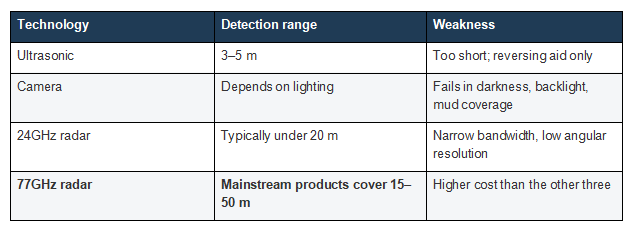
77GHz sees through rain, fog, and dust, and it measures speed natively — that second point is covered in Question 4, and it is the key to whether drivers will keep the system switched on.
Longer range is not automatically better; it depends on vehicle type and duty cycle. See Question 5.
It depends where your trucks are sold. The regulations that are systematically mandatory today are mainly in Europe:
UN R151 requires trucks to detect and warn about cyclists and other vulnerable road users to the side during turns; UN R159 covers the front blind spot at pull-away.
Other markets vary widely — some adopt UN regulations directly, some have their own national standards, and some have no mandatory requirement yet. What I would suggest:
They will. And this is the most common problem in the industry, and the least openly discussed.
Many projects fail not because the radar is inaccurate, but because a driver pulled the cable.
This is exactly why you choose radar over camera, and the difference is physical:
Accurate alerts earn driver trust; driver trust is what keeps the system actually working on the vehicle.
By vehicle type and real duty cycle, not by "bigger is better":
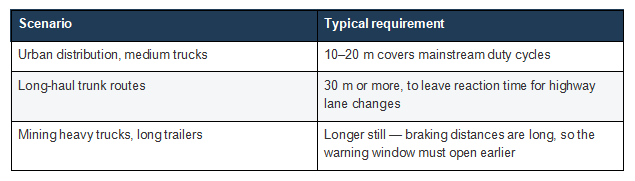
Here is a simple way to decide: take your vehicle's braking distance at full load, add the driver's reaction time (use 1.5 seconds), and work backwards to the warning distance you need. Any product below that number is not enough, however good its spec sheet looks.
Look for IP69K ingress protection — it withstands high-pressure, high-temperature washing. That is a real requirement for mining, construction sites, and wash bays, not a paper specification.
Millimeter wave does not depend on visible light, which is its fundamental advantage over camera:
One honest caveat: ingress protection solves water and dust, but it does not solve a sensor face fully covered in thick mud. If your duty cycle is heavy dust, mounting position and a regular cleaning routine matter just as much — and no product brochure will emphasize that.
Integrated design with single-cable routing keeps installation under 1.5 hours per vehicle.
For a fleet, the more important question is how you schedule installation windows, not how long one unit takes:
On mixed-type fleets, the key is not installation speed but interface consistency: the same bracket, the same harness, and the same calibration parameters, so your own maintenance team can handle it instead of waiting for the factory's people for every single vehicle.
Three questions are worth more than a hundred pages of brochure:
① Is the production line IATF 16949 certified?
That is the quality-system threshold for the automotive industry. Without it, the main customer base is not vehicle OEMs or Tier 1 suppliers.
② Do you have operating data from genuinely harsh environments — mining sites, deserts, the Nordics?
Lab data is easy to produce. Long-term field data from real environments is the evidence that something "holds up".
③ Will spare parts still be available in five years?
Few people ask this, but it decides whether your system is a whole-life asset or a pile of unrepairable parts three years from now.
One extra suggestion: look at how long the factory has existed. Among commercial vehicle electronics suppliers, an established plant and a young one answer the three questions above in completely different ways — it is not a question of capability, but of how many product life cycles they have been through. A supplier that has only built one generation has not yet had the chance to learn what its product looks like three years in.
Don't take a supplier's payback figure. Calculate it yourself:
Payback (months) = Fleet size × Unit price ÷ Annual saving × 12
Annual saving = Fleet size × Incidents per vehicle per year × Cost per incident × Accident reduction rate
What decides the result is not the unit price — it is incidents per vehicle per year. Double that number and payback halves; for a fleet that rarely has incidents, no system will show a payback at all.
Take a 50-vehicle fleet, 0.5 incidents per vehicle per year, $15,000 cost per incident, and a conservative 40% reduction: annual saving comes to about $150,000. Plugging in unit prices:

These prices are illustrative, not our quotation — replace them with the real quote once you have it.
It depends where the cheapness comes from, and it usually comes from one of three places:
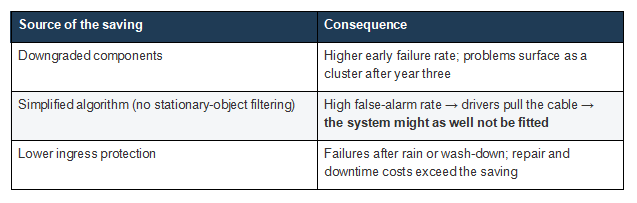
The real cost is not the purchase price — it is how much the system actually does on the vehicle. A system that gets installed and then switched off by the driver cannot be cheap enough to pay for itself.
We have been building commercial vehicle safety systems for twenty-three years, from 24GHz to 77GHz, from radar alone to radar-vision fusion.
C93 is our 77GHz system, with 30 m detection range, covering mainstream urban distribution and long-haul trunk duty cycles. Where longer range is needed, the PWAS series (C58D at 40 m, C63 at 50 m) fills the gap. Together they cover essentially every blind-spot scenario in a commercial fleet.
Our factory is IATF 16949 certified; products carry CE and E-Mark approval, with IP69K ingress protection.
But ultimately, there is no standard answer in system selection — your vehicles, your duty cycles, and your accident rate are what decide it. If you are unsure, send us your fleet details and we will run the numbers on your data. That will be more accurate than any brochure.
Published: October 2026 | Written by the CISBO engineering team
Accident costs and reduction ranges in this article are industry reference figures; actual results vary with operating environment, installation quality, and driver behavior. The calculation model is for reference only — use your own data.
Shenzhen CISBO Technology Co., Ltd. specializes in automotive electronic products including BSD, PWAS, AI monitoring, parking sensors, and rear view systems. With 23 years of experience and global certifications, we deliver high-quality solutions for safer driving. Explore our products and services today.
6F, Building 3, Lijincheng Industry Park, Gongye East Road, Longhua, Longhua New District, Shenzhen, 518109, China
Copyright © 2026 Shenzhen CISBO Technology Co., LTD. All rights reserved. Privacy Policy 粤ICP备:05005734号