Mon - Fri: 9:00 - 19:00
 EN
EN

Mon - Fri: 9:00 - 19:00
Provide a practical framework for fleet operators, distributors, and OEM buyers to evaluate blind spot detection system manufacturers before placing orders.
Finding the right blind spot detection system supplier should be straightforward - but for most buyers, it's not. You may have sent inquiries to five suppliers, and only three may have responded with standard forms. One supplier's quote changed after the sample, and another couldn't provide the compliance documents required for your market. Six months later, you're still undecided.
The real challenge lies not in whether the blind spot detection system technology is effective, but in whether the supplier can deliver on time, maintain stable quality, control costs, and consistently provide a stable supply in the future.
Below is a practical evaluation framework.
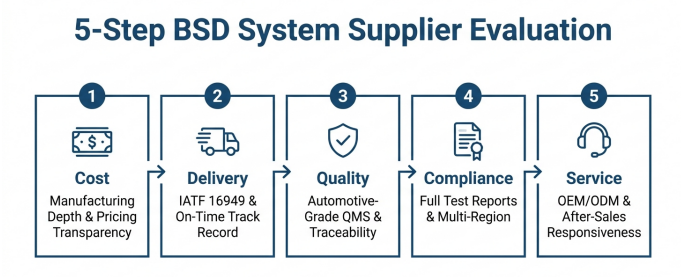
1. "The quotation will change after placing the order" - cost transparency
When purchasing a blind spot detection system, one of the most common challenges is the escalation of hidden costs. Some suppliers may quote highly competitive prices to win sample orders, and then raise prices in subsequent bulk orders under the pretext of "price fluctuations in raw materials" or "customization surcharges". If you encounter such a situation, you may be dealing with an intermediary trading company rather than the actual manufacturer.
You need to pay attention to the following aspects:
1.1 Direct manufacturing capability. A factory capable of producing its own radar sensors, control units, and cable assemblies can control prices, whereas trading companies are unable to do so.
1.2, verifiable production capacity.
2. "Double the delivery time for samples and mass production" - delivery reliability
Delivering samples within a week seemed promising. However, the first bulk order took eight weeks, and the second order took even longer.
How to evaluate delivery reliability:
2.1 IATF 16949 certification. This is not an ordinary quality certification mark, but a standard in the automotive industry, requiring documented process control, traceability, and corrective measures.
2.2 We have our own SMT and assembly production lines.
2.3 Tracking records from order to shipment.
3. "The defect rate of each batch of products is different" - quality consistency is the key to distinguishing between partners and problems
The first batch of products passed inspection perfectly, but the next batch may have other quality issues. When the defect rate fluctuates, your incoming inspection costs will increase.
Evaluation criteria:
3.1 Automotive-grade quality management. IATF 16949 and ISO 9001 are benchmarks. Inquire whether the supplier conducts incoming inspection, process inspection, and final inspection according to documented acceptance criteria, rather than just final visual inspection.
3.2 Component traceability: You need the supplier to identify the root cause within days, not weeks.
3.3 Product durability is a manifestation of quality.
4. "Obtain the required compliance documents" - certification is your stepping stone to enter the market
5. "Support disappears after the first shipment" - Service determines long-term value
The product is theoretically feasible. However, when your installation personnel reports a calibration issue in an extreme situation that requires after-sales support, the supplier's after-sales service capability becomes crucial.
Evaluate service capability:
5.1 Customized R&D support. Can the supplier adjust the detection range, alarm logic, or cable length according to your requirements?
5.2 The flexibility of OEM/ODM reflects the depth of engineering.
5.3 Prompt technical communication.
How to find a manufacturer of blind spot detection system that can address all five dimensions? If you are evaluating manufacturers of BSD systems, the following information may be of reference to you:
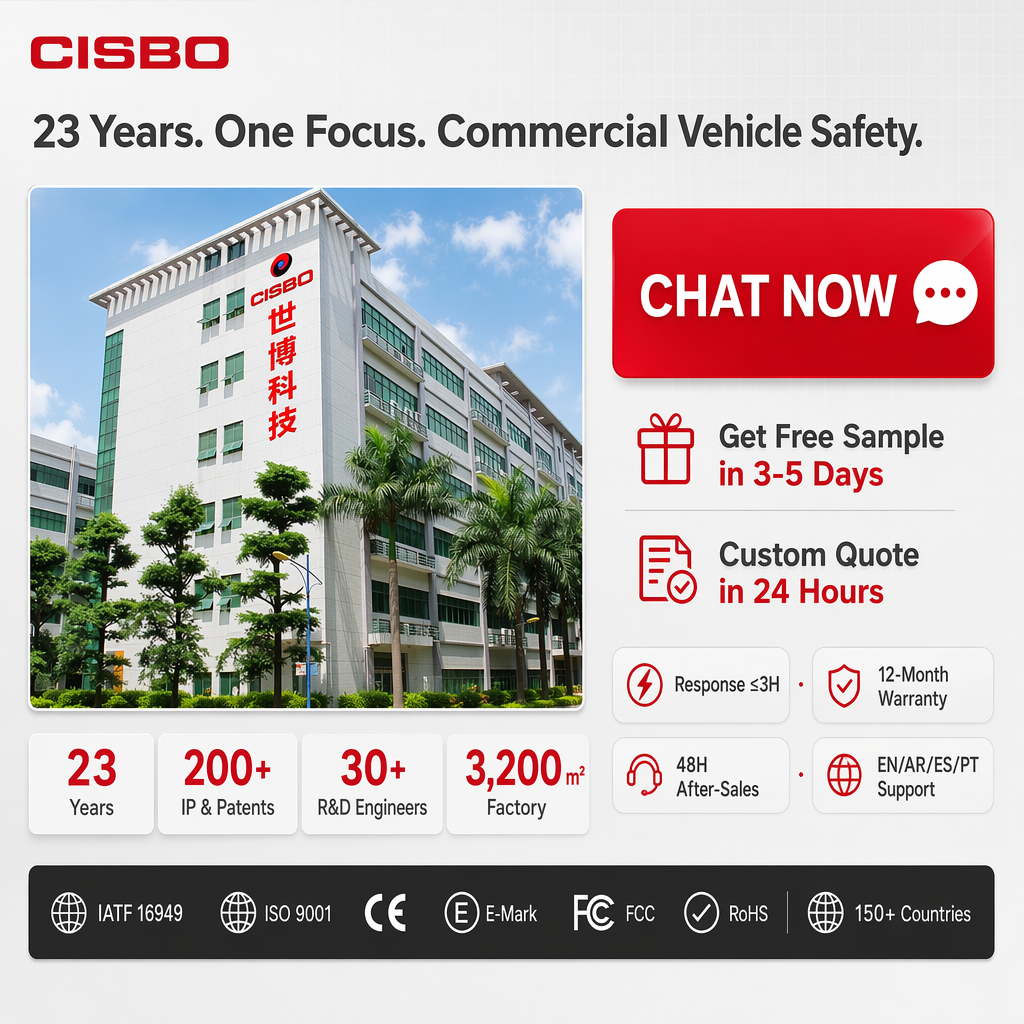
CISBO boasts a factory with 23 years of professional experience - certified by IATF 16949, equipped with manufacturing production lines, ISO9001 certified, and capable of OEM/ODM.
CISBO's C93 BSD system is directly produced at the company's Shenzhen factory, which boasts an independently developed radar sensor production line with a monthly production capacity exceeding 100,000 units, thus ensuring stable pricing and continuous delivery.Quality: IATF 16949 and ISO 9001 certifications cover incoming inspection, process inspection, and final inspection, and provide complete batch traceability.
Compliance: C93 has obtained CE RED/EMC certification, and can provide a complete test report upon request. Additionally, it also provides other compliance documents (RoHS, EN 62471), suitable for multi-regional deployment.
Service: CISBO provides OEM/ODM customization and direct R&D support, boasting 23 years of experience in the production of commercial vehicle safety systems.
CISBO — 23 years of experience in commercial vehicle safety systems | IATF 16949 certified | Shenzhen, China
Shenzhen CISBO Technology Co., Ltd. specializes in automotive electronic products including BSD, PWAS, AI monitoring, parking sensors, and rear view systems. With 23 years of experience and global certifications, we deliver high-quality solutions for safer driving. Explore our products and services today.
6F, Building 3, Lijincheng Industry Park, Gongye East Road, Longhua, Longhua New District, Shenzhen, 518109, China
Copyright © 2026 Shenzhen CISBO Technology Co., LTD. All rights reserved. Privacy Policy 粤ICP备:05005734号