Mon - Fri: 9:00 - 19:00
 EN
EN

Mon - Fri: 9:00 - 19:00
I have spent twenty-three years in the commercial vehicle safety systems industry.
Over those years, I've heard many commercial vehicle customers tell the same story — "The cyclist right beside the truck — the driver never saw them at all."
It's not that the driver wasn't looking. It's the blind zone in the mirrors — and on a day of heavy rain, nothing can be seen clearly anyway.
Today, let's talk about a legal rule: UN R151.
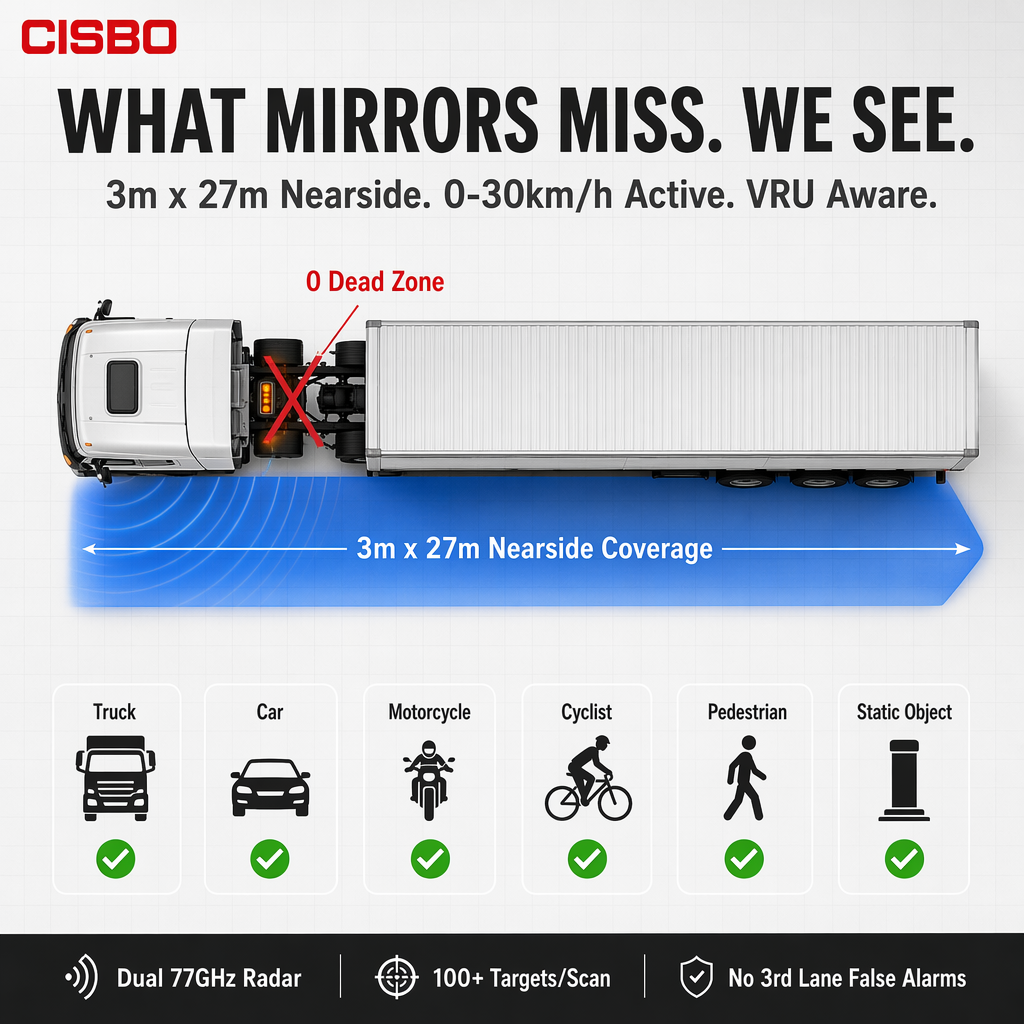
The comprehensive promotion of the EU General Safety Regulation (GSR2) has made UN ECE R151 (i.e. Blind Spot Information System BSIS protocol) a heavy responsibility,The 'entry ticket' for trucks to enter the international market.
In plain terms: R151 requires that a commercial vehicle blind spot detection system on any M2/M3/N2/N3 vehicle be able to detect pedestrians and cyclists in the blind zone during right turns or low-speed driving, and warn before a collision happens.
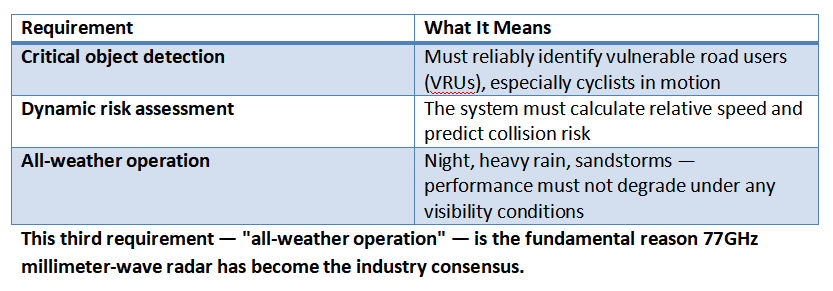
Three hard requirements:
If you've followed the leading players in commercial vehicle safety — or compared truck blind spot detection systems recently — you'll notice a clear trend.
Bosch, the world's largest automotive supplier, uses the 77GHz band across its commercial vehicle millimeter-wave radar line. Continental and Denso follow the same path. All of the world's top three millimeter-wave radar manufacturers have bet on 77GHz.
This is no coincidence.
The logic behind it is simple: compared with lower-frequency bands, 77GHz offers a shorter wavelength and wider bandwidth. That means:
We have tested this ourselves: in heavy dust, the camera can barely see, but the 77GHz radar keeps working — detection range drops from 40 meters to 35 meters, but it is still working.
In the "all-weather" scenarios R151 demands, 77GHz radar is currently the only reliable solution proven at mass-production scale.
Many blind spot detection systems on the market rely on camera-only approaches. Cameras are good at answering "what is this," but in real commercial vehicle operating conditions they have one unavoidable weakness: sensitivity to light and shadow. Swaying tree shadows, oncoming headlights, glare off the road surface, the harsh light-dark transition when entering or leaving a tunnel — in all these scenarios, camera-only BSD easily misjudges changes in light and shadow as "a person," triggering false alarms. After dozens of false alarms a day, the driver no longer trusts the system.
77GHz millimeter-wave radar is not affected by light or shadow. It detects targets through electromagnetic reflections and does not depend on visible light. Under blazing midday sun, in total darkness at night, or through the harsh light-dark switch at a tunnel entrance, radar detection performance stays consistent.
More importantly, 77GHz radar has a native speed-measurement capability — it can tell you "that target is moving, at what speed, and in which direction." This allows the system to filter out stationary lampposts and guardrails, and alarm only on moving targets that pose a real collision risk.
Fewer false alarms means drivers stop switching the system off. And only a system that stays on makes R151 compliance meaningful.
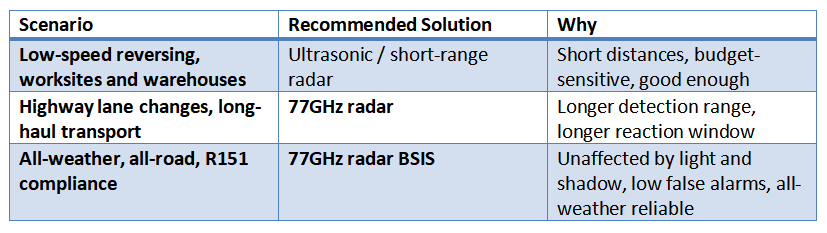
I've been at this for twenty-three years and have seen too many customers agonize over "which technology to pick." The decision logic is actually simple:
*Published: September 2026 | CISBO — 23 years of commercial vehicle safety system manufacturing, IATF 16949 certified, Shenzhen, China. www.szcisbo.com
Shenzhen CISBO Technology Co., Ltd. specializes in automotive electronic products including BSD, PWAS, AI monitoring, parking sensors, and rear view systems. With 23 years of experience and global certifications, we deliver high-quality solutions for safer driving. Explore our products and services today.
6F, Building 3, Lijincheng Industry Park, Gongye East Road, Longhua, Longhua New District, Shenzhen, 518109, China
Copyright © 2026 Shenzhen CISBO Technology Co., LTD. All rights reserved. Privacy Policy 粤ICP备:05005734号