Mon - Fri: 9:00 - 19:00
 EN
EN

Mon - Fri: 9:00 - 19:00
After twenty-three years developing commercial vehicle proximity warning systems, I've heard the same question in every fleet manager's office:
"How long until this thing pays for itself?"
A fair question. Safety is a business decision — let me answer it with math, not promises.
1. The "Iceberg Cost" of Blind Spot Accidents
Most managers only see what's above the waterline: repair bills and medical compensation. The truck gets fixed, nobody is hurt — and three months later profit is quietly down by tens of thousands.
The problem sits below the waterline:
Downtime. A 200-ton mining truck in a blind spot collision sits in the shop two or three days; a day of lost hauling capacity often costs an order of magnitude more than the repair.
Insurance escalation. One Middle East fleet had four blind spot claims in three years; the insurer refused to renew, and the replacement policy cost double with a higher deductible.
Compliance risk. UN R151 — the truck blind spot detection system standard — and R159 are already mandatory in the EU. Without compliant systems, the question isn't "should we install?" — it's "can we still enter this market?"
Add it up: the real cost of one "minor" blind spot collision is typically 3 to 5 times the book repair cost.
2. Technology Choice Sets the Ceiling on ROI
Pick the wrong sensor technology, and ROI bleeds from day one. Two mainstream approaches, each with its own math.
Pure vision: low upfront cost, but run the full numbers
One camera plus an AI board is cheap and intuitive. But real deployments expose three hidden costs:
Weather failure. In a Saudi desert sandstorm, effective detection range can drop from 30 meters to under 5. Not a bad product — physics. Cameras need to see.
Lens maintenance. Mine mud, cement dust, road salt — a dirty lens blinds the system, and a 50-truck fleet pays for manual cleaning all year.
False alarm fatigue. Misread shadows and guardrails startle drivers ten times a day; by day three they switch the blind spot detection system off. Investment: zero.
Pure vision fits urban delivery at low-to-medium speeds in clean, budget-sensitive operations.
77GHz radar + AI vision fusion: higher upfront cost, better lifecycle ROI
Radar fusion costs more — but run the math over five years, not day one.
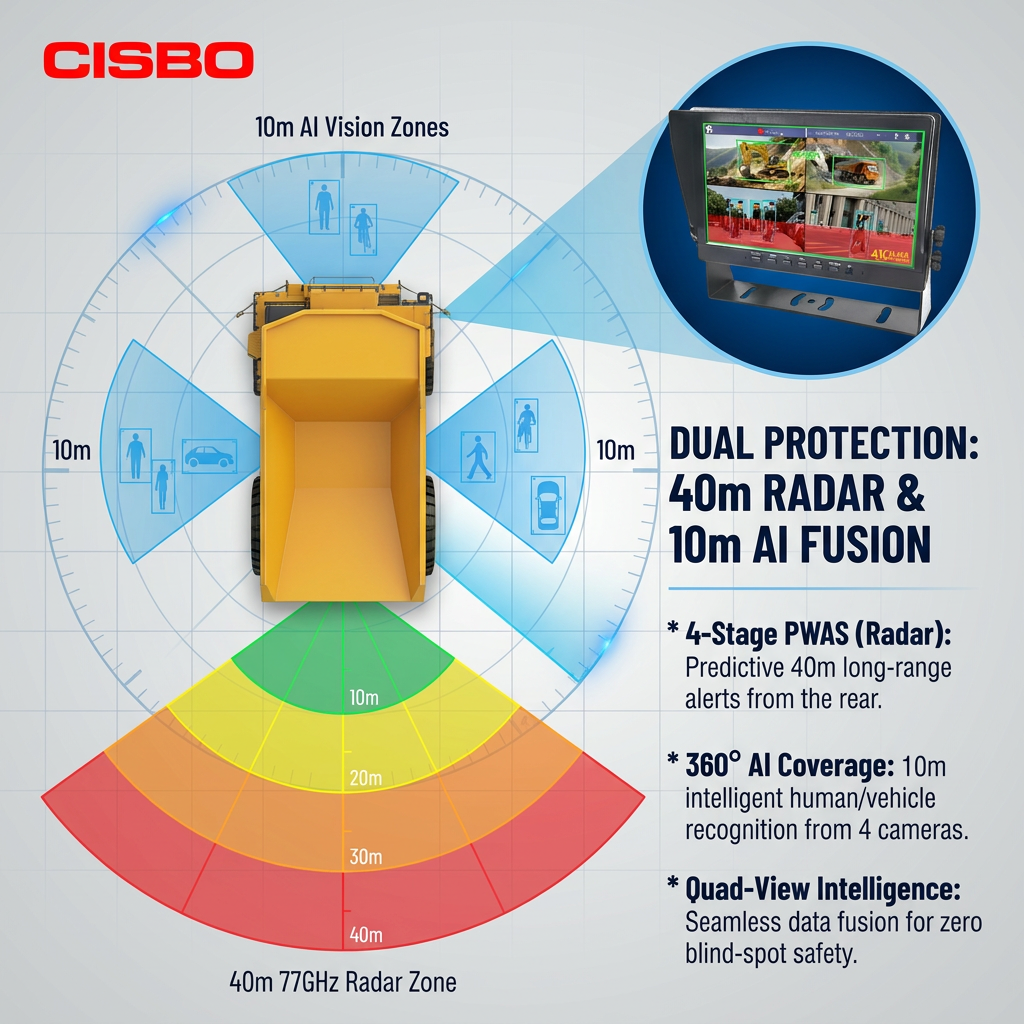
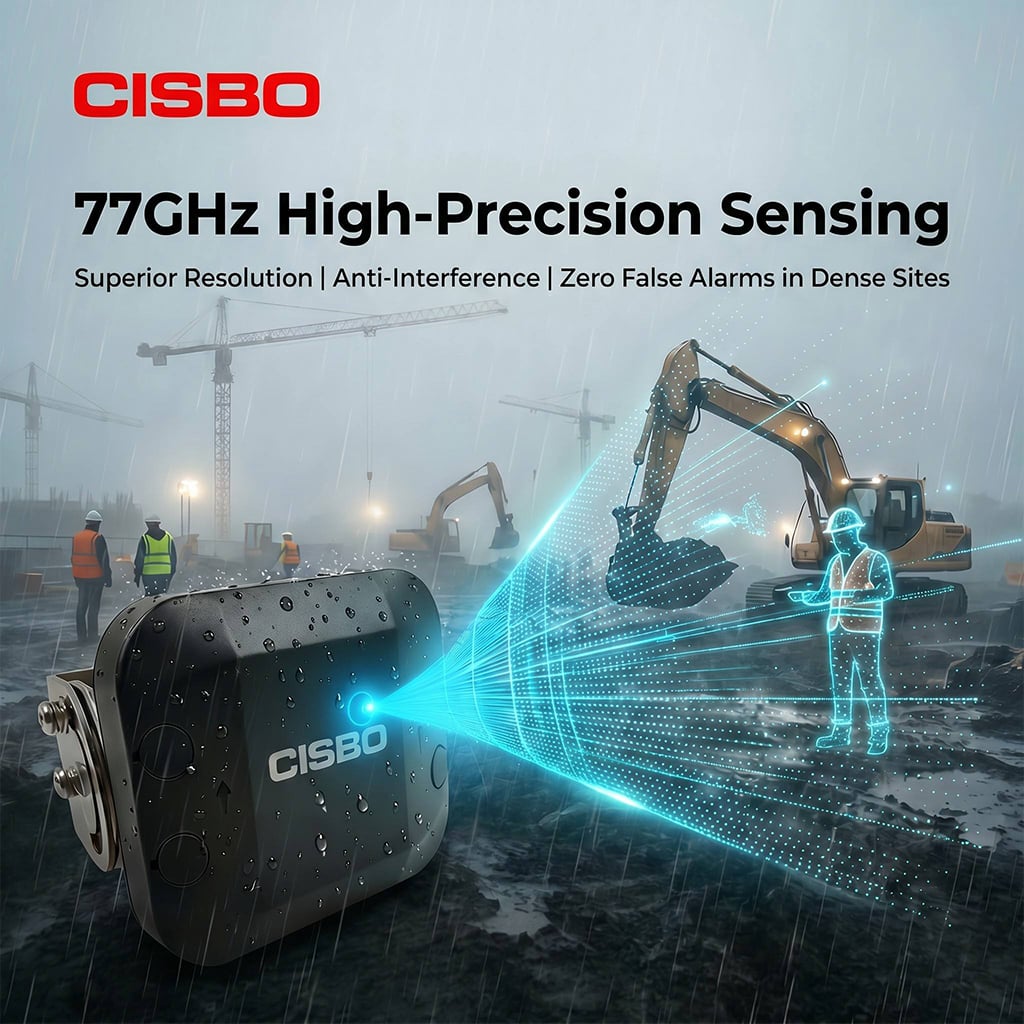
A 77GHz millimeter-wave radar ignores dust, rain, fog, and darkness: in the same sandstorm it still detects targets at 50 meters. AI answers "what is it?"; the radar confirms "where, and how fast?" — so false alarms drop far below single-sensor systems. With no lens to clean, an Australian mining fleet ran it two years with zero extra maintenance — "install it and forget it exists, but it never stops working."
Radar fusion fits long-haul, mining, construction, and cross-border transport. It's not about which technology is better — it's about which fits your operation.
3. Scenario-Based ROI Calculations
Construction site: the key is accurate identification
A mixer truck reverses through a narrow corridor — scaffolding right, three workers left. In backlighting, pure vision can't tell scaffolding from human outlines and alarms constantly, until the driver switches it off. Radar fusion measures distance and speed while an AI monitoring system recognizes human contours, warning only when someone actually enters the danger zone — so drivers trust it.
ROI logic: one avoided mixer-truck pedestrian strike by the PWAS system saves compensation plus site shutdown, remediation, and insurance escalation — potentially a full year's BSD budget.
Open-pit mine: the key is detection range
A 200-ton truck runs the haul road at 40 km/h. Within 30 meters on its right, the driver sees nothing; from the moment a service vehicle enters that blind zone to impact, 4 to 5 seconds. A 50-meter proximity detection system for mining warns before the vehicle even enters the blind zone — those extra 2 to 3 seconds are the line between life and death.
ROI logic: one day of mining-truck downtime can cost over $50,000 in lost output. Prevent one collision with a heavy duty vehicle collision warning system and the investment is recovered several times over.
Cross-border transport: the key is compliance and data
A Turkey-to-Germany truck with a BSD data logger is side-swiped in Germany. The other driver claims the truck changed lanes. The fleet manager pulls the log — timestamps, speed, fleet safety proximity alerts, relative position — a complete chain of evidence. Ruling: the other driver, fully at fault.
ROI logic: one successful liability defense can cover the entire fleet's BSD investment in saved compensation and legal fees — before counting premiums that don't rise.
4. A Concrete ROI Calculation Example
A sample model for a hypothetical fleet:
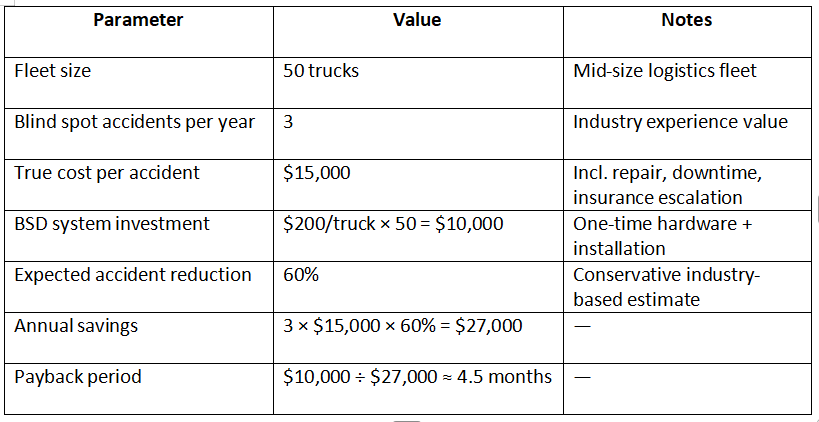
Note: a sample calculation — run the model with your own fleet's real data.
5. Choosing a System Is Really Choosing a Partner
A truck BSD system — unlike a car blind spot detection system — runs five to ten years. Whether the supplier keeps delivering, supporting, and tracking new regulations matters more than the initial quote. Three questions:
Is your production line IATF 16949 certified? (The baseline for any commercial vehicle supply chain.)
Do you have real-world data from mines, deserts, and cold regions — not just lab results?
If I need spare parts in five years, will you still be here? (A 23-year-old factory and a 3-year-old one give different answers.)
Safety is not a cost center — it's a profit center. But only with the right technology, the right scenario, and the right partner.
*Published: September 2026 | CISBO — 23 years of commercial vehicle safety system manufacturing, IATF 16949 certified, Shenzhen, China. www.szcisbo.co
Shenzhen CISBO Technology Co., Ltd. specializes in automotive electronic products including BSD, PWAS, AI monitoring, parking sensors, and rear view systems. With 23 years of experience and global certifications, we deliver high-quality solutions for safer driving. Explore our products and services today.
6F, Building 3, Lijincheng Industry Park, Gongye East Road, Longhua, Longhua New District, Shenzhen, 518109, China
Copyright © 2026 Shenzhen CISBO Technology Co., LTD. All rights reserved. Privacy Policy 粤ICP备:05005734号