Get a Free Quote

Our representative will contact you soon.
Email
Name
Company Name
Mobile/WhatsApp
Message
0/1000
where are the safety gaps in the blind spots of heavy equipment   did you choose the right sensor-1

Insights

Home >  News >  Insights

Where are the safety gaps in the blind spots of heavy equipment? Did you choose the right sensor?

Time: 2026-08-25

In the winter of 2019, at a copper mine in Chile, the Safety Director pointed to a half-meter deep pool of muddy water next to a mining truck tire and asked me: "Can your sensors survive and function normally in this environment?"

Those mining trucks rolled through 30 cm of thick mud daily. Their previous fleet was equipped with ultrasonic sensors, and the performance had been disastrous.

I didn't answer directly. Instead, I asked him: "Where are your vehicles running, and what specific problem are you trying to solve?"

After 23 years developing commercial vehicle proximity warning systems, visiting dozens of fleets across the Middle East, South America, and Australia, this is my deepest realization: When choosing a detection system, don't look at the price first—look at the application scenario.
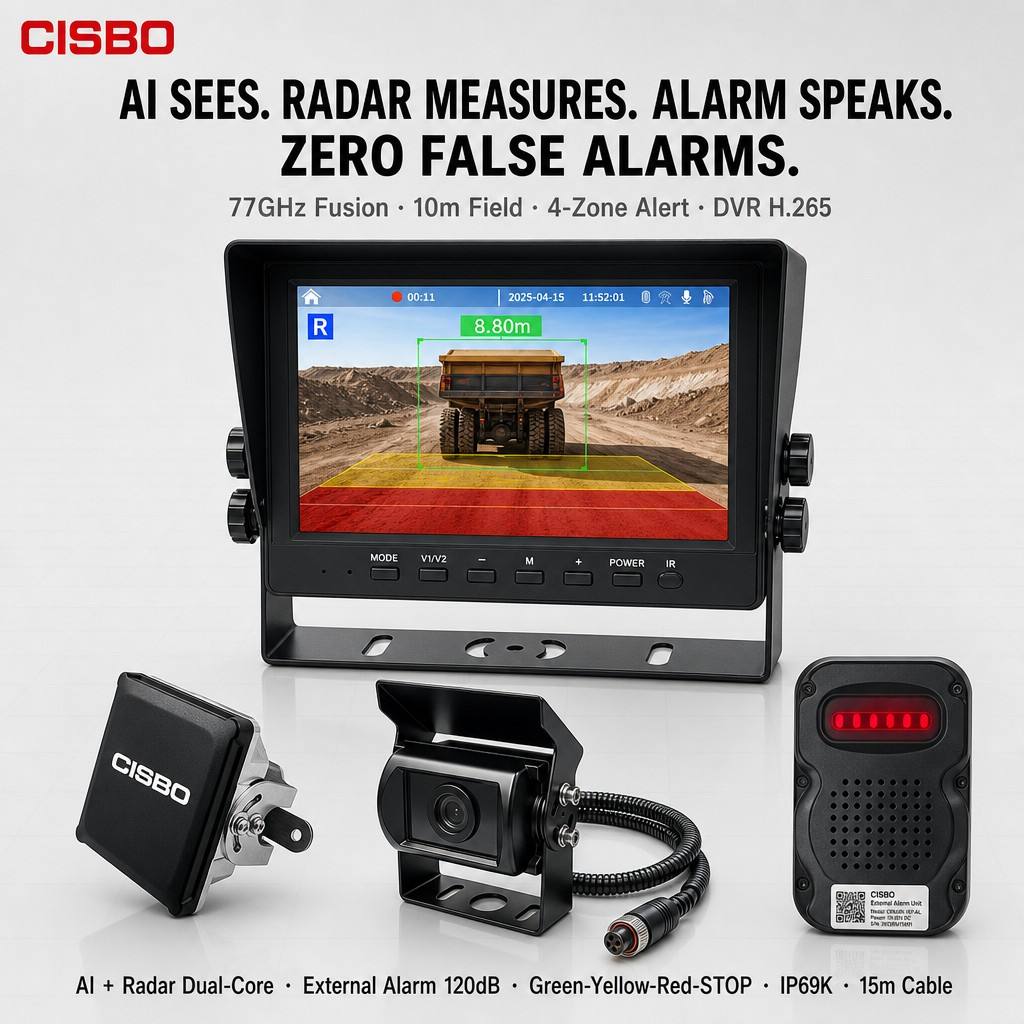
C98AIR-107-11B-A1.jpg

I. Construction Sites: The Ability to Distinguish "People" from "Concrete Blocks"

On construction sites, the core challenge for a blind spot detection system isn't detection range—10 meters is usually sufficient. The real test is twofold: precision recognition and environmental toughness.
  • Precision Matters: Mixer trucks reverse in tight spaces surrounded by workers. Standard ultrasonic sensors will beep, but they can't distinguish between a human being and a concrete wall. The result? Drivers become numb to frequent false alarms and eventually turn the system off. An installed but ignored sensor is useless.
  • AI + 77GHz Fusion: This is where AI vision and 77GHz technology become critical. The camera "sees" the target—identifying whether it's a person, a block, or a stray plastic bag. The 77GHz radar calculates the exact distance. The fusion system only alerts when there's genuine danger, ensuring drivers take every warning seriously.
  • The IP69K Baseline: Site equipment faces high-pressure jet washing and mud splatter daily. If your proximity warning sensor isn't IP69K rated (capable of withstanding steam cleaning and high-temp/high-pressure water), it's not safety equipment—it's a time bomb that could fail silently at any moment.77Ghz PWAS 1.jpg

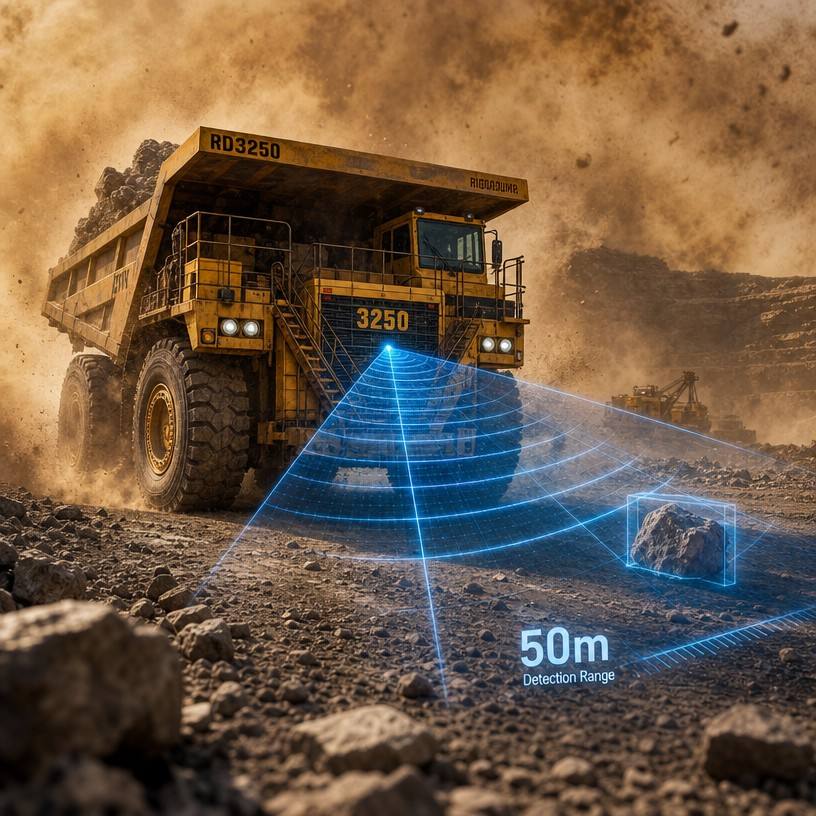
II. Mining Operations: 50m Detection Range = A 5-Second Escape Window

If construction sites test precision, mining tests physical limits. A heavy duty vehicle collision warning system for a 200-ton mining truck must handle braking distances exceeding 50 meters.

  • The Physics of 77GHz:In sandstorms with less than 5 meters of visibility, ultrasonic sensors fail as sound waves attenuate rapidly. Cameras go blind as lenses get caked in mud within minutes. 77GHz millimeter-wave radar is the only choice. It doesn't "see"; it "perceives." Much like a bat navigating a dark cave, it emits electromagnetic waves that penetrate dust, rain, and fog to calculate distance and speed.
  • The 5-Second Rule:For our Chilean clients, we configured a 50-meter proximity detection system for mining operations. This extra distance provides a 5 to 8-second reaction window. At a mine site, 5 seconds is the difference between life and death.

III. Logistics & Transport: Regulations are an Entrance Ticket

For long-haul logistics, the battlefield is the open highway. Here, wide coverage must meet strict regulatory compliance.

  • EU Standards: Europe has two major hurdles: UNECE R151 (BSIS) requires trucks to detect pedestrians/cyclists in the passenger-side blind spot, and R159 (MOIS) requires detection at the front during takeoff. Without these, your vehicles cannot enter the EU market.
  • The Power of Data Logs: Modern fleet management requires evidence. CISBO PWAS systems include a built-in data logger. Every emergency brake or fleet safety proximity alert is recorded with time, location, and video clips—accessible via a mobile app. This isn't just for insurance; it's the most effective tool for driver safety training.

The Three-Step Selection Process

Before choosing a truck blind spot detection system, ask yourself these three questions in order:

  • Check Vehicle & Blind Spots: Unlike a basic car blind spot detection system, a truck's blind zones are far larger and taller. How big is the truck? Where are the blind zones? What distance is required?
  • Observe Environment: Is it a 50°C Middle Eastern site or a -30°C Chilean mine? Is there high-pressure washing or sandstorms?
  • Verify Compliance: Do you need EU E-Mark/R151 or North American DOT certification?

The order matters: Scenario first, technology second, price last.

Every cent saved on safety equipment is eventually paid back tenfold in accident claims.

📩 Reversing on a site or crossing a sandstorm? Tell us your vehicle model and environment, and we’ll show you the system that brings your drivers home safe every night.

*Published: August 2026 | CISBO — 23 years of commercial vehicle safety system manufacturing, IATF 16949 certified, Shenzhen, China. www.szcisbo.com

PREV : The Real Cost of Blind Spot Accidents: A Fleet Manager's Guide to Calculating BSD System ROI

NEXT : What Is a PWAS System? Proximity Warning for Commercial Vehicles

where are the safety gaps in the blind spots of heavy equipment   did you choose the right sensor-2

Get a Free Quote

Our representative will contact you soon.
Email
Name
Company Name
Mobile/WhatsApp
Message
0/1000