Mon - Fri: 9:00 - 19:00
 EN
EN

Mon - Fri: 9:00 - 19:00
I've spent twenty-three years in commercial vehicle safety systems. The question I hear most often is not "What are your product specifications?" It's this:
"Do you have a cheaper option?"
Every time I hear it, I pause and ask one question back. I'll tell you what that question is in a moment.
First, two real-world scenarios. They could save you far more money than the price of a truck blind spot detection system.
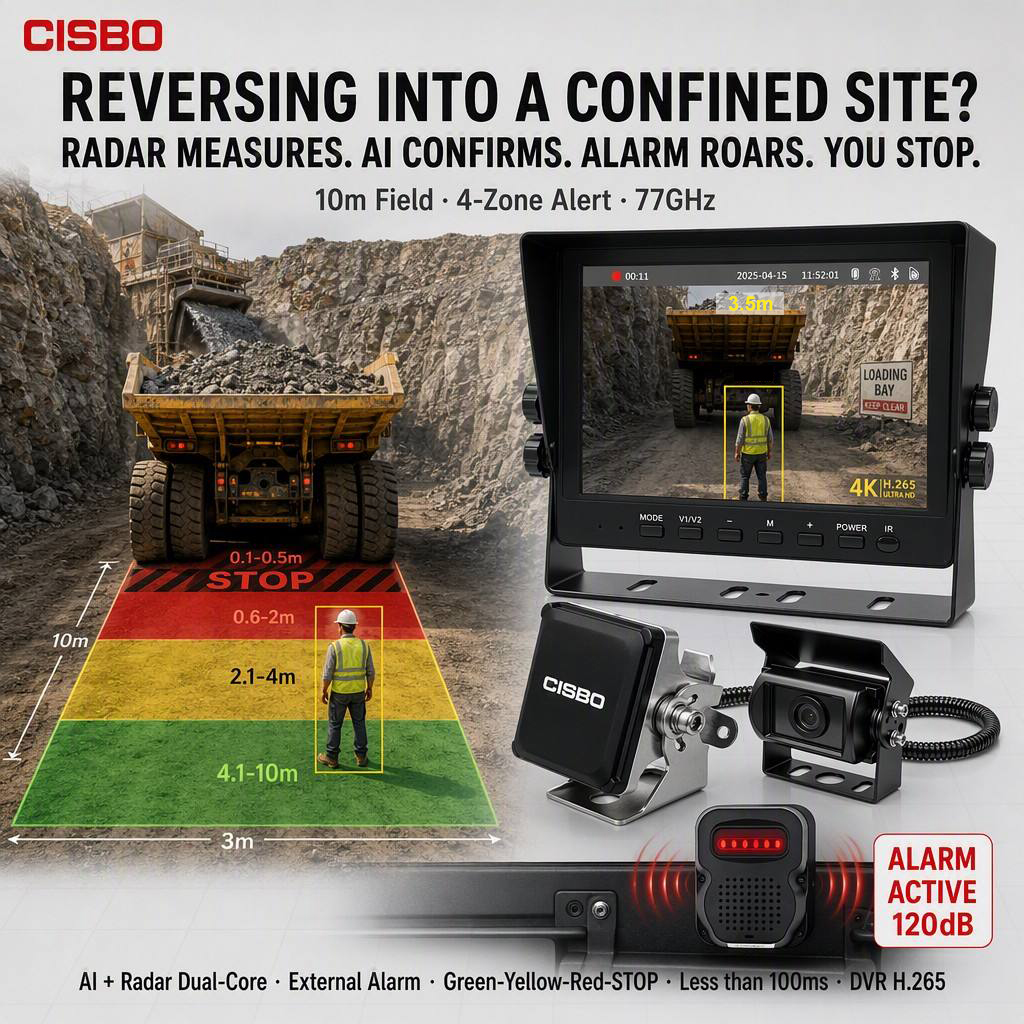
A fully loaded fuel tanker cruises down a highway at 80 km/h. Then a sandstorm hits, and visibility drops from hundreds of meters to less than ten. Under these conditions, the camera of an AI-only visual BSD is essentially blind. The screen turns into a blur of sand — the algorithm cannot tell whether that mass ahead is a cloud of dust or a broken-down car. The heavy duty vehicle collision warning either stays silent, or throws false alarms.
At the same moment, on a truck equipped with 77GHz millimeter-wave radar, the detection range of 30 meters barely changes. Radar emits electromagnetic waves — sand and dust are almost transparent to it.
This is not lab data. This is physics. The camera is an eye; the radar is an ear. Eyes fear darkness, fog, and sandstorms. Ears do not.
A 200-ton haul truck reverses along a haul road. In the blind zone behind it, two workers are walking — and a concrete barrier stands by the roadside. The camera-based AI monitoring system starts to classify: is that human-shaped outline a worker, or a shadow next to the concrete barrier? The system alarms — but when the driver glances at the screen, the alert is on the concrete barrier. After a few rounds of this, the driver switches the system off.
A fleet safety proximity alert that gets switched off has an ROI of zero. Not because the product is bad, but because the driver doesn't trust it. Once false alarms pile up, human instinct is to turn it off. This is the most common — and most expensive — failure mode in fleet management.
So what does a 77GHz radar + AI vision fusion proximity detection system for mining sites do differently here?
AI answers "what is it" — a person or a concrete barrier. Radar answers "where is it, and how fast" — that target is 3 meters from the truck, approaching at 1.5 m/s. Only when both answers agree does the alarm sound. When they don't match, it stays silent.
Drivers trust a blind spot detection system like this. Because it doesn't cry wolf. Every time it sounds, it's real.
Whenever someone asks me "Do you have a cheaper option?", I ask in return:
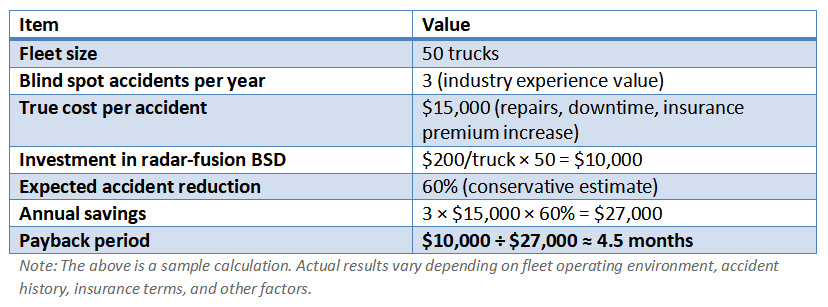
"Are you counting the cost on day one, or the cost in year five?"
For simple car blind spot detection, camera-only solutions do cost less to purchase. If your fleet runs urban delivery routes at low-to-medium speeds in clean environments, it's a reasonable choice — I'm not saying it's bad. I'm saying it has its place.
But if your trucks run through mines, construction sites, long-haul highways, sandstorms, and blizzards — the money you save on day one can come back doubled in year three, in the form of accident compensation, downtime losses, and higher insurance premiums.
A PWAS system or BSD lives on a truck for five to ten years. Over that decade, whether the supplier can keep delivering, provide technical support, and keep up with evolving regulations — these matter far more than the initial quote.
When evaluating suppliers, ask them a few questions:
A factory with 23 years of history and one with 3 years will give you very different answers.
*Published: September 2026 | CISBO — 23 years of commercial vehicle safety system manufacturing, IATF 16949 certified, Shenzhen, China. www.szcisbo.com
Shenzhen CISBO Technology Co., Ltd. specializes in automotive electronic products including BSD, PWAS, AI monitoring, parking sensors, and rear view systems. With 23 years of experience and global certifications, we deliver high-quality solutions for safer driving. Explore our products and services today.
6F, Building 3, Lijincheng Industry Park, Gongye East Road, Longhua, Longhua New District, Shenzhen, 518109, China
Copyright © 2026 Shenzhen CISBO Technology Co., LTD. All rights reserved. Privacy Policy 粤ICP备:05005734号