Mon - Fri: 9:00 - 19:00
 EN
EN

Mon - Fri: 9:00 - 19:00
Three technologies, one question: at 100 km/h in a sandstorm, which one will help you spot the motorcycle in your blind spot?
After 23 years building commercial vehicle safety systems, here's what we've learned.
We've sat in fleet manager meetings on three continents. The opening line is almost always the same:
"We want to install blind spot detection. What's the cheapest option?"
Our answer is almost always the same: "Let's first talk about what accidents you're trying to prevent — then we'll talk cost."
Because the three technologies on the market — 40 kHz ultrasonic, camera vision, and 77 GHz millimeter-wave radar — are not three price points of the same thing. They are three completely different tools. Choose wrong, and you're not saving money — you're planting a time bomb.
| 40 kHz Ultrasonic | Camera Vision | 77 GHz Radar | |
|---|---|---|---|
| Detection range | 3–5 m | 10–30 m (conditions dependent) | 40–50 m |
| Usable for highway lane change | ❌ | ⚠️ Degraded performance | ✅ |
| Usable at night | ✅ (relies on sound) | Requires supplemental light | ✅ |
| Usable in rain, fog, dust | ❌ | ❌ | ✅ |
| Distinguishes static vs. moving targets | ❌ | ⚠️ Algorithm-dependent | ✅ (Doppler) |
1. 40 Khz Ultrasonic: Cheap, Short-Range, Nearly Useless Above 30 Km/H
Ultrasonic sensors measure distance by sound-wave reflection. Every passenger-car reversing radar uses them. For reversing into a parking spot — low speed, close range — they work fine.
But on a truck?
Detection range is only 3–5 meters. On the highway, from the moment the target is detected to the moment of impact, the driver has less than 0.2 seconds to react. The motorcycle is already gone.
Rain, dust, mud caked on the sensor? The signal degrades directly. In Middle East sandstorms and Southeast Asian monsoon rain, ultrasonic is essentially blind.
Can't tell a guardrail from a person. Anything that reflects sound triggers an alarm. The driver will eventually turn it off.
Where it works: reversing, low-speed maneuvering.
Where it doesn't: everywhere else.
2. Camera-Based Systems: It Sees — Until It Can't
Camera-based BSD relies on image recognition to detect vehicles and pedestrians. It has one genuine advantage: it produces a picture. You can see what the object is. If an accident happens, you have footage as evidence.
But as a detection system, it has a fundamental physical flaw:
It depends on light. At night, at tunnel entrances and exits, with glare hitting the lens directly — recognition accuracy drops off a cliff. The moment you need it most is exactly when the picture is at its worst.
It depends on weather. Rain spray, fog, dust on the lens. A truck that has run for hours on a mining-site dirt road has a lens caked with mud. It sees nothing.
It depends on algorithms. AI object detection has come a long way, but it still "hallucinates" — shadows misread as vehicles, unusual vehicles missed entirely. For a safety system, "works most of the time" is not good enough.
Where it works: as a visual supplement — recording footage, giving the driver a screen to look at.
Where it doesn't: as the only blind spot detection method. A camera is an eye. You still need ears.
3. 77 Ghz Millimeter-Wave Radar: The Only Technology That Doesn't Care About The Weather
This is the core of what we build. Here's why.
77 GHz radar emits electromagnetic waves and measures the Doppler shift of the reflected signal. It directly measures two things: distance and relative speed. It needs no light, no clean lens, and doesn't need to "recognize" anything — a metal object moving at 80 km/h has a radar signature determined by the laws of physics. It cannot be missed.
What that actually means:
Sandstorm? No effect. Radar penetrates dust.
Heavy rain? No effect. Radar penetrates water spray and fog.
3 a.m. on a highway with no streetlights? No effect. Radar carries its own "light source."
Sensor caked with mud? We've tested it. It keeps working.
Stationary guardrail vs. an approaching motorcycle? The radar distinguishes them instantly — one has zero relative velocity, the other doesn't.
4. So Which One Should You Buy?
The answer is not "always radar." It depends on the problem you're solving:
| Your situation | Our recommendation |
|---|---|
| "I need reversing radar for my delivery vans." | Ultrasonic is sufficient. |
| "I want a camera so the driver can see behind the vehicle." | A camera is the right choice. |
| "I want to prevent highway lane-change collision accidents." | You need 77 GHz radar. |
Most of the fleets we work with end up at the fourth option. Start with radar — solve the core safety problem — then add cameras to give drivers confidence and recorded footage, and keep ultrasonic for reversing. But if the budget only covers one system, prioritize safety — install 77 GHz radar blind spot monitoring first.
That's why our C93 series — the 77 GHz commercial vehicle radar blind spot monitoring system — is designed specifically for large vehicle blind zones.
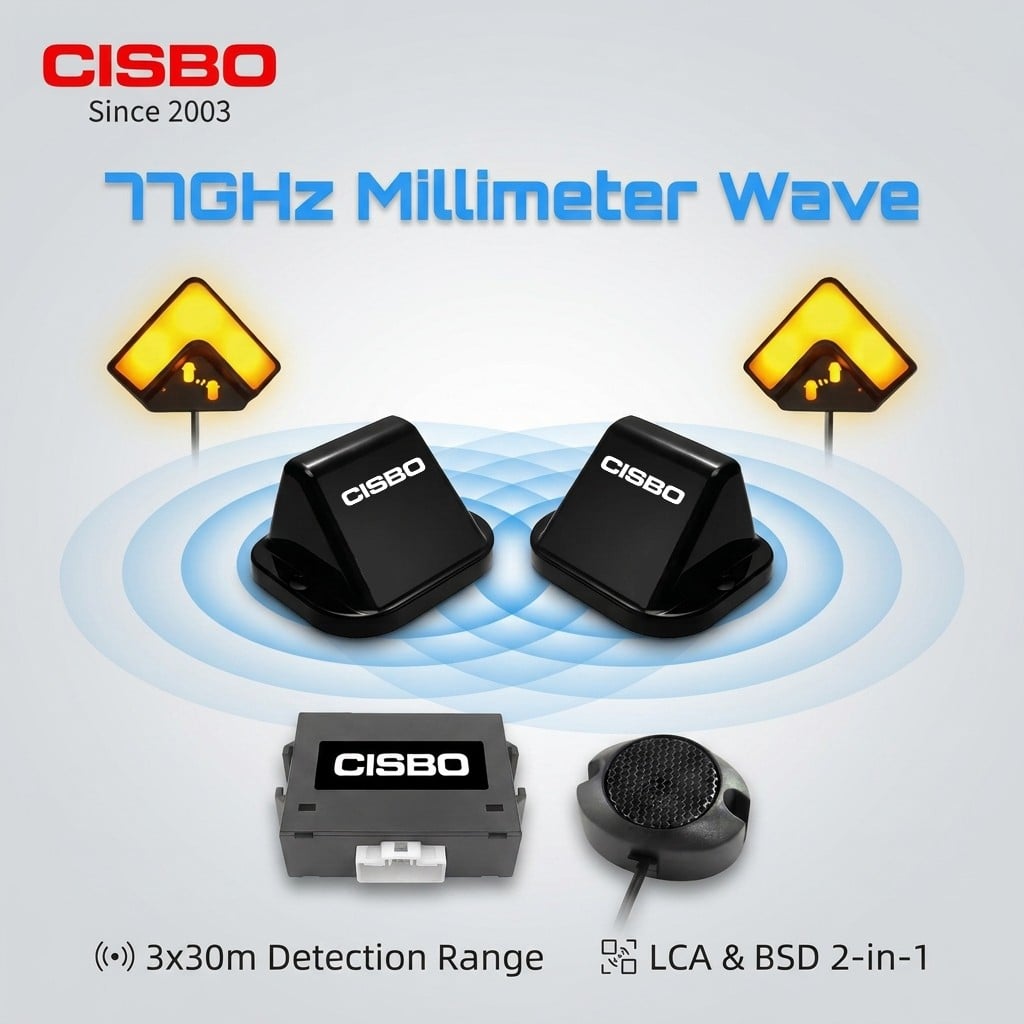
If you're evaluating blind spot detection solutions for your fleet and want to understand the pros and cons of each technology for your specific vehicle types and operating conditions, contact us.
Published: August 2026 | Author: CISBO Engineering Team — 23 years of commercial vehicle safety system manufacturing experience, IATF 16949 certified, Shenzhen, China
Shenzhen CISBO Technology Co., Ltd. specializes in automotive electronic products including BSD, PWAS, AI monitoring, parking sensors, and rear view systems. With 23 years of experience and global certifications, we deliver high-quality solutions for safer driving. Explore our products and services today.
6F, Building 3, Lijincheng Industry Park, Gongye East Road, Longhua, Longhua New District, Shenzhen, 518109, China
Copyright © 2026 Shenzhen CISBO Technology Co., LTD. All rights reserved. Privacy Policy 粤ICP备:05005734号