Mon - Fri: 9:00 - 19:00
 EN
EN

Mon - Fri: 9:00 - 19:00
A mining dump truck is reversing on a worksite. Behind the vehicle — in an angle the mirrors can't see, the cameras can't capture — a worker is walking across. The driver doesn't see him. By the time anyone realises, the distance is too short, and there's no time to brake.
This is the scenario a PWAS system is designed to prevent. Not theory. Not "nice to have." It's a documented cause of fatalities around heavy commercial vehicles, repeated across job sites worldwide. If you operate trucks, construction equipment, or mining machinery, understanding what PWAS is and how to evaluate one is no longer optional.
What Is a PWAS System?
PWAS stands for Proximity Warning Alert System. It is a radar-based safety system installed on commercial vehicles to detect people and obstacles in areas the driver cannot see — directly behind, to the sides, and around the vehicle during reversing and low-speed manoeuvring.
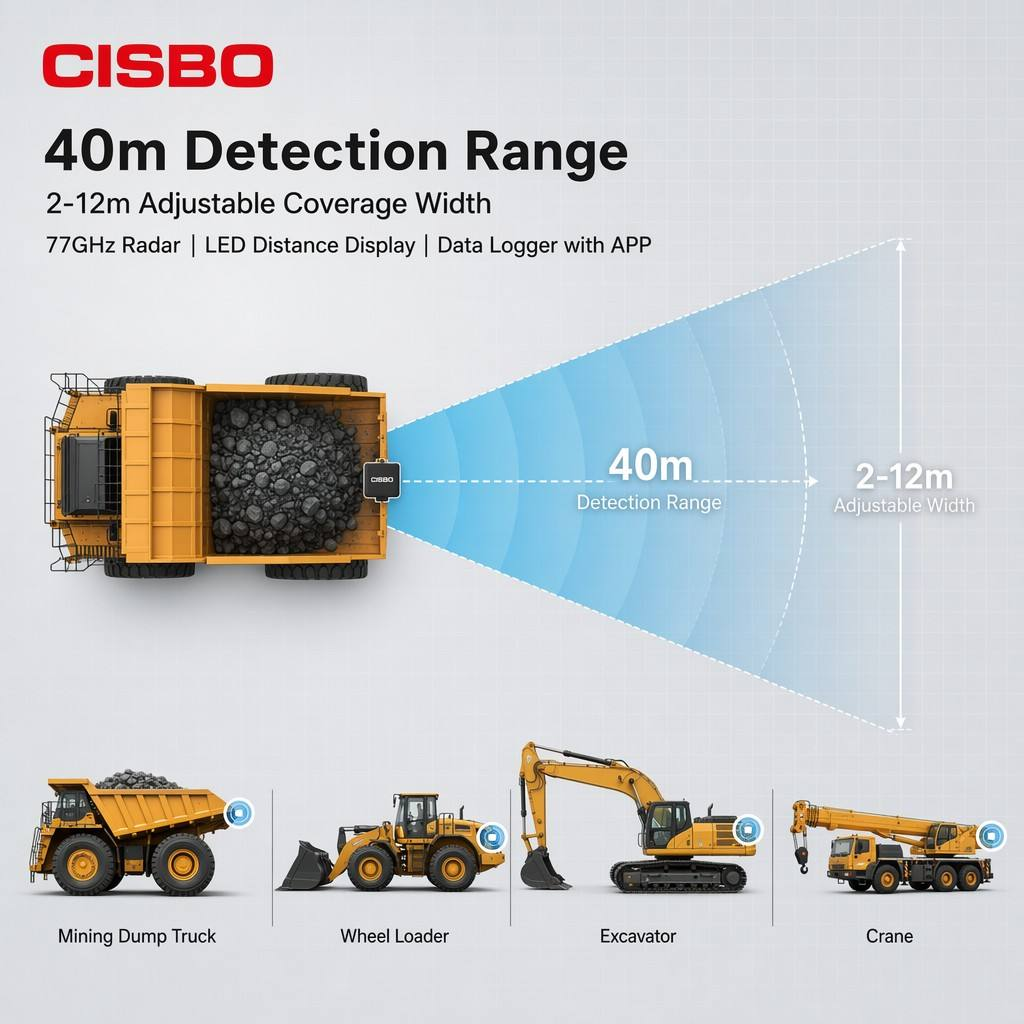
The core sensing technology is 77GHz millimetre-wave radar. Unlike cameras, radar is not blinded by dust, rain, fog, or darkness. Unlike ultrasonic sensors, it maintains stable detection at long range and under vibration. The PWAS radar sensor continuously scans the rear area (and optionally the front and sides), distinguishes between stationary and moving targets, and relays the information to an in-cab display and alarm.
Let's be clear about what PWAS actually detects: not just pedestrians, but also stationary obstacles (walls, bollards, parked vehicles) and moving objects (other vehicles, cyclists). In other words, it protects people and prevents equipment damage.
How Does PWAS Work?
A complete PWAS operates as a closed loop: Detect → Display → Alarm → Log.
This last point is more important than it first appears. When an incident occurs, the event log tells you what the system detected, when it detected it, and how the driver responded. That data is invaluable for post-incident review, insurance claims, and driver training.
What to Look for When Evaluating a PWAS
Not every system labelled "proximity warning" delivers the same value. Here are the dimensions worth checking, one by one.
Detection range vs. vehicle match. This is the most critical parameter, and it varies widely. A compact forklift may only need 5–15 metres of rear coverage. A long-haul heavy truck or a mining dump truck may need 40 to 50 metres to cover the full blind zone. Buy a system with too short a range and you leave blind spots. Go far beyond what you need and you waste budget. The best approach is to match the range to the actual blind-zone length of your vehicle.
Beam angle and detection width. A wider horizontal angle (120°–130°) and configurable detection width mean the radar covers not just the area directly behind the vehicle, but also adjacent lanes and approaching traffic from the rear. For vehicles reversing in tight, cluttered environments, width coverage catches targets that a narrow beam would miss.
Environmental toughness. Mining, construction, and quarry vehicles operate in extreme conditions. At minimum, you need −40°C to +85°C operating temperature and IP69K-rated sensors — meaning they can withstand high-pressure, high-temperature washdowns, dust immersion, and steam-jet cleaning. A system that survives every harsh environment you throw at it is the kind of system a fleet manager should be considering.
Data logging and app integration. A PWAS that only buzzes is an alarm. A PWAS that records every event and lets you replay logs on a mobile app is a safety management system. If your operations are subject to worksite safety audits or insurance reviews, log capability provides the evidence you need when it counts.
Regional compliance certifications. Different markets require different certifications. Before specifying a system, verifying the compliance documentation is an essential step.
Voltage and fleet compatibility. A 9–36V DC wide-voltage system works with both 12V and 24V electrical architectures without additional converters. For mixed fleets, this covers the requirements of different vehicle platforms.
A Product Line That Covers the Full Distance Spectrum
CISBO has built a PWAS product family on a 77GHz radar platform, covering detection distances from 10 metres to 50 metres to meet different vehicle requirements — all on a unified hardware and software foundation:
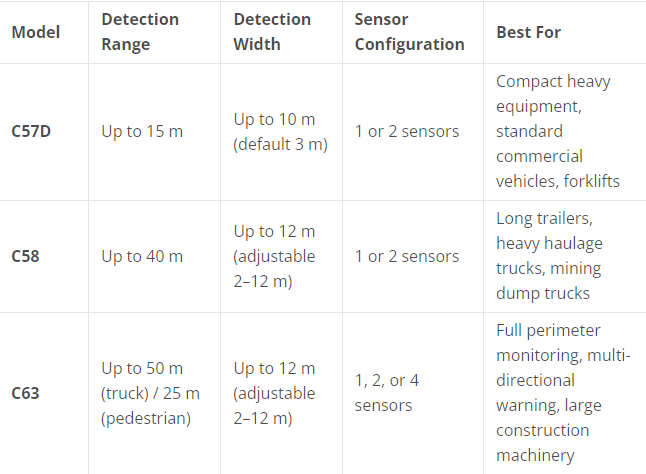
All three models share the same technology foundation: 9–36V wide-voltage compatibility, −40°C to +85°C operating temperature, IP69K sensor protection, and mobile app data logging. The only differences are detection range and sensor count — choose based on your vehicle's blind-zone size and the coverage directions you need. Don't pay for range you don't need.
Summary
PWAS is not a camera. It's not a rear-view mirror. And it's not an ultrasonic parking sensor. It is a purpose-built radar system designed to detect people and obstacles in the blind zones of heavy commercial vehicles — warning the driver before contact, not after.
When evaluating a PWAS, the questions that actually matter are practical ones: Does the range cover my vehicle's blind zone? Will it function reliably in my operating environment? Can it log events I can actually use? Is it certified for every market I operate in?
Get those answers right, and the PWAS system pays for itself on the first incident it prevents.
*Published: August 2026 | CISBO — 23 years of commercial vehicle safety system manufacturing, IATF 16949 certified, Shenzhen, China. www.szcisbo.com
Shenzhen CISBO Technology Co., Ltd. specializes in automotive electronic products including BSD, PWAS, AI monitoring, parking sensors, and rear view systems. With 23 years of experience and global certifications, we deliver high-quality solutions for safer driving. Explore our products and services today.
6F, Building 3, Lijincheng Industry Park, Gongye East Road, Longhua, Longhua New District, Shenzhen, 518109, China
Copyright © 2026 Shenzhen CISBO Technology Co., LTD. All rights reserved. Privacy Policy 粤ICP备:05005734号