Mon - Fri: 9:00 - 19:00
 EN

Mon - Fri: 9:00 - 19:00
I've spent twenty-three years in commercial vehicle safety. The most common purchasing mistake I've seen is not buying something too expensive — it's buying the wrong thing.
The most typical case is treating PWAS (proximity warning) and BSD (blind spot detection) as the same category — both are called "radar," both are mounted on the vehicle, both alert the driver. But they are not built to solve the same problem.
PWAS manages "how far the vehicle is from an obstacle." It works like a measuring tape: it can tell you the distance, but not what the object is.
BSD manages "whether there is a vehicle in the blind zone." It works like a pair of eyes: it can recognize the target, but cannot tell you precisely how many meters away it is.
A tape measure can't identify objects; eyes can't measure meters. The side that buys wrong often doesn't find out until the day of an accident.
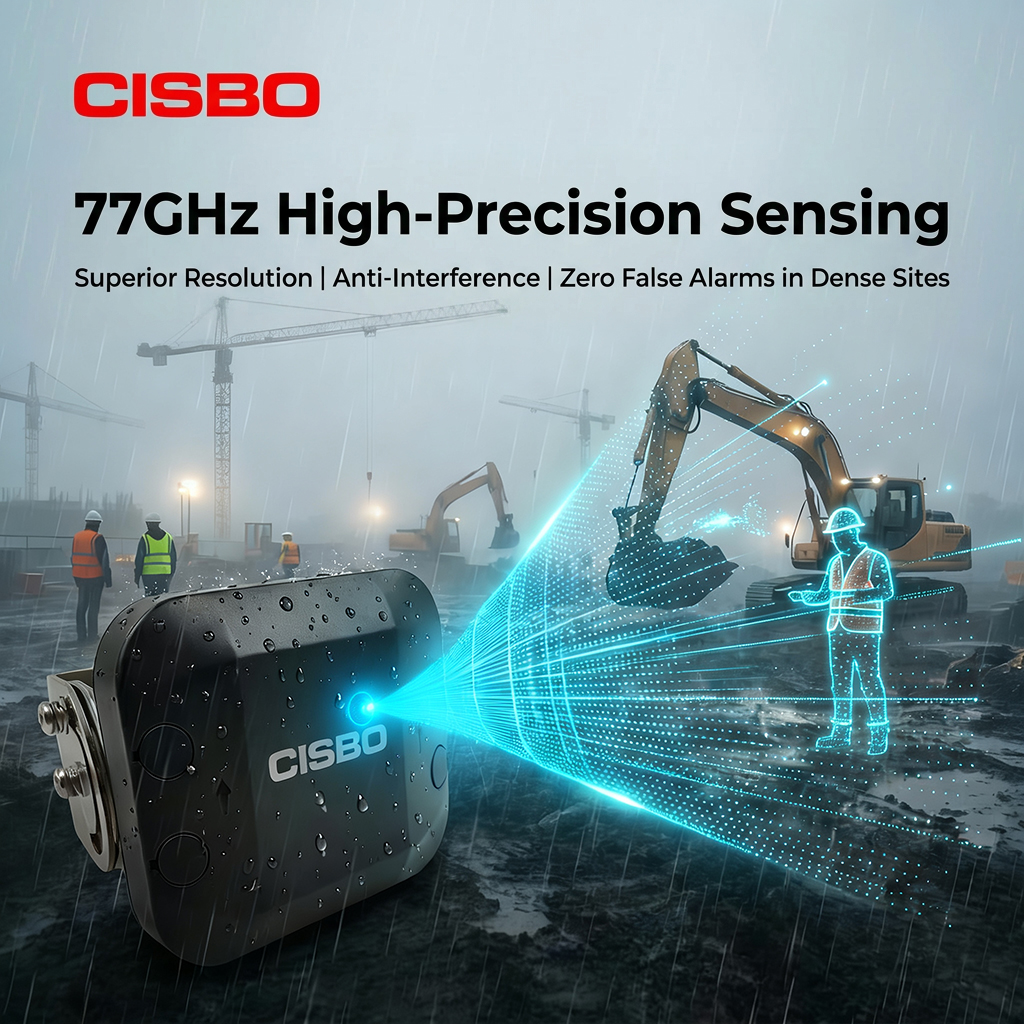
What PWAS faces are mostly static and slow-moving things — walls, utility poles, cargo piles, warehouse doors, and coworkers standing behind the vehicle. They won't dodge; they just sit there waiting for the vehicle to approach. Typical operations: reversing into bays, dock loading, repositioning on site, unloading in mines.
CISBO's PWAS is tiered by detection range: C57 series 10–15 m, for entry-level reversing and small equipment; C58D 40 m, the main choice for forward detection and long trailers; C63 50 m (25 m for pedestrians), and C63-4 with four sensors for 360° coverage.
Longer range is not always better. A 15-meter device in a 50-meter scenario leaves the middle zone uncovered; a 50-meter device on a forklift only creates false alarms.
Roads are full of guardrails, streetlights, medians, and headlights from oncoming traffic — present everywhere but irrelevant to safety. If all of them triggered alarms, drivers would switch the system off in no time — and a switched-off system equals no system at all. So BSD's real job is to pick out the one target that will actually be hit. Typical operations: highway lane changes, overtaking, merging.
CISBO's BSD comes in two lines: C52 and C6F are 24GHz — more stable at low-to-medium speeds and in dusty, high-vibration environments, at lower cost; C91, C93, C95L/C95M and C96 are 77GHz — longer range, higher resolution. This is a division of labor, not an upgrade.
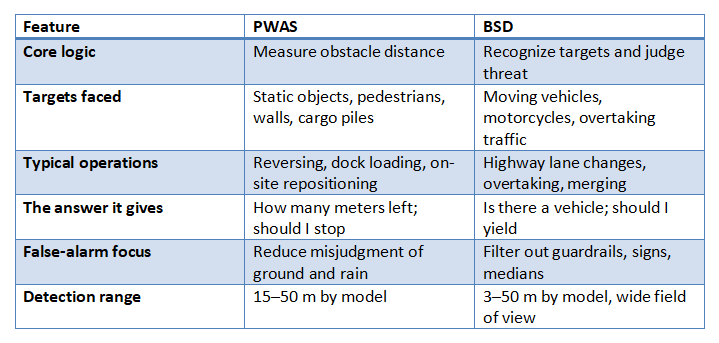
Using BSD to assist reversing doesn't work. To suppress guardrail false alarms, BSD sets a higher trigger threshold for static targets. But what you need to avoid when reversing is exactly the static stuff — warehouse doors, cargo piles, dock edges. The result: the vehicle may already be touching the door while the system stays silent.
Putting PWAS on a highway truck makes it cry all the way. As long as an object is within range, it alarms by distance. On the road, guardrails, streetlights, medians, and tunnel walls are all within range. The result is nonstop alarms — until the driver pulls the power. That is more dangerous than not installing it at all, because the fleet believes it already has this layer of protection.
Real fleets are rarely a choice between one or the other. The most typical case is a long-haul dump truck: it runs tens of kilometers of highway from the quarry to the site, where BSD handles lane changes; then it reverses to unload on site, next to workers and excavators, where PWAS handles close range. One vehicle, two operating conditions — neither system can replace the other.
So the first question at purchase is not "PWAS or BSD?" but "How many kinds of risk does your vehicle face in a single day?"
Both types share a common weakness: they know "how far," but not "what." A person, a motorcycle, and a concrete barrier can look almost the same in the echo; the system can only guess from size and speed.
So more and more projects add vision on top: radar handles ranging and speed, unaffected by light, rain, or fog; vision handles recognition. This is what the C98AIR is built to do.
But fusion is not a cure-all — cost, installation complexity, and calibration requirements are all higher than a single-sensor solution. It is only worth it when you genuinely need to solve "recognition" and "ranging" at the same time.
1. At what speed does your vehicle mainly operate? Below 30 km/h, mainly reversing and dock work → start with PWAS. Running on highways with risk concentrated in lane changes → start with BSD. Both → get both.
2. What are you most afraid of hitting? Things that don't move (walls, cargo piles, platforms) → PWAS. Vehicles overtaking from behind or merging alongside → BSD. Afraid of hitting people and unable to tell a worker from a machine → consider a fusion product.
3. Will your drivers keep it switched on? This is the most overlooked question, and the most important. Too many false alarms and drivers will switch it off for sure. The question to ask is not "can it detect?" but "will it go off all day long?"
There is no master key in this industry. I've seen fleets that bought the most expensive fusion system and left most of its functions unused because nobody did the calibration; and I've seen the simplest ranging radar solve years of reversing run-over incidents — because that was the real pain point.
Don't start with "which is better." Start with "what am I most afraid of."
CISBO has spent twenty-three years in commercial vehicle safety — from radar to vision to fusion. If you're choosing a system, or running one that doesn't feel right, tell us your situation. Together we'll figure out whether it's the equipment, or the selection.
November 2026 | CISBO, Shenzhen — 23-year professional manufacturer of commercial vehicle safety systems, IATF 16949 certified | www.szcisbo.com
Shenzhen CISBO Technology Co., Ltd. specializes in automotive electronic products including BSD, PWAS, AI monitoring, parking sensors, and rear view systems. With 23 years of experience and global certifications, we deliver high-quality solutions for safer driving. Explore our products and services today.
6F, Building 3, Lijincheng Industry Park, Gongye East Road, Longhua, Longhua New District, Shenzhen, 518109, China
Copyright © 2026 Shenzhen CISBO Technology Co., LTD. All rights reserved. Privacy Policy 粤ICP备:05005734号