Mon - Fri: 9:00 - 19:00
 EN

Mon - Fri: 9:00 - 19:00
From tractor to trailer, from fixed combinations to drop-and-hook — the blind zone of an articulated vehicle is a moving problem.
Twenty-three years in commercial vehicle safety systems has taken me into a lot of fleet managers' offices. The same mistake keeps coming up: when the conversation turns to blind spot detection, attention goes straight to the tractor unit. The logic runs that once the tractive unit carries a 77GHz radar and an AI camera, the safety line is complete.
My view is blunt: if you operate semi-trailers, doing the tractor only means covering half the blind zone. And the real failure point is usually not in the product at all. It is in the moment you swap trailers.
I will start with the failure, not the physics. Fleets do not spend money on principles. They spend it on failures.
Drop-and-hook is the engine of modern logistics. From a calibration standpoint, it is also where accidents cluster. Plenty of systems perform perfectly in a lab and come apart the first time they meet a real trailer swap.
The cause comes down to one thing: the calibration reference has changed. Every trailer differs slightly in length, wheelbase and radar mounting height. If the system runs on fixed calibration, hanging a new trailer behind the tractor shifts the coordinate framework the system was set up against. The result goes to one of two extremes. Either false alarms spike, and the guardrail along the road starts triggering the system; or the system goes quiet at the wrong moment, and a target that has already entered the danger zone is never picked up.
When drivers are worn down by endless false alarms, they switch the system off. And a system the driver has switched off has a return of zero.
The real challenge, then, is not the hardware. It is whether the system can recognise a new trailer's parameters and correct its warning logic after hooking up — working the moment it is connected, rather than waiting on a phone call.
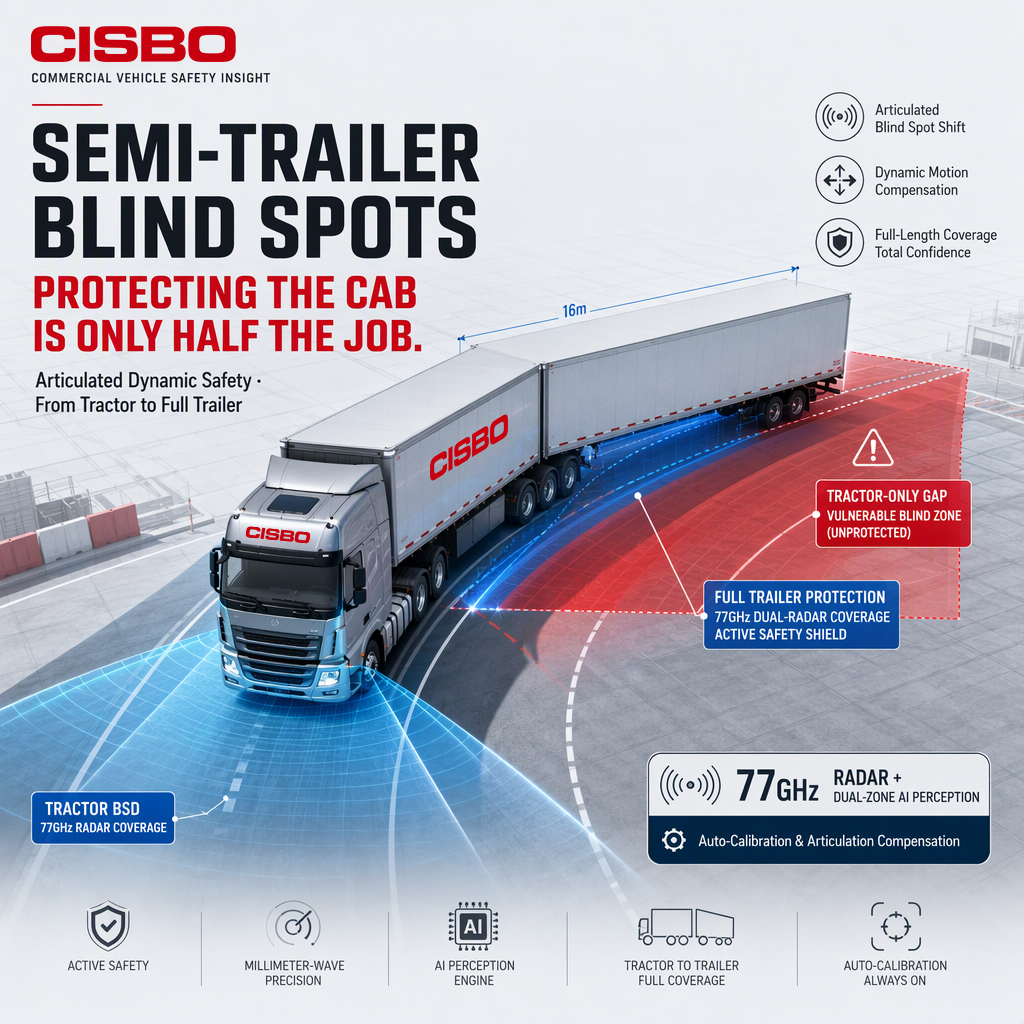
What separates a semi-trailer from a rigid truck is the articulation. The blind zone is not a fixed shape wrapped around the body; it is a region that shifts in real time with the articulation angle.
If blind spot detection is fitted only to the tractor's sides, the geometry comes apart in a bend. As the trailer swings out or folds, the radar's coverage area separates from where the trailer's actual danger zone has moved to. Put another way, an articulated vehicle's blind zone is not the tractor's blind zone plus the trailer's blind zone. It is a single region that moves with the angle of the joint.
Without attitude sensing or motion compensation, the radar is painting an area that is no longer the dangerous one, while pedestrians and cyclists caught in the squeeze along the trailer's inner side sit in the gap. This is also why a general truck blind spot system cannot simply be carried over to an articulated vehicle: the general system assumes the blind zone stays where it was put, and on a semi-trailer it does not.
Before specifying anything, a fleet needs to settle what kind of operation it runs, rather than reaching for the highest specification on the list. The two modes pose entirely different problems:
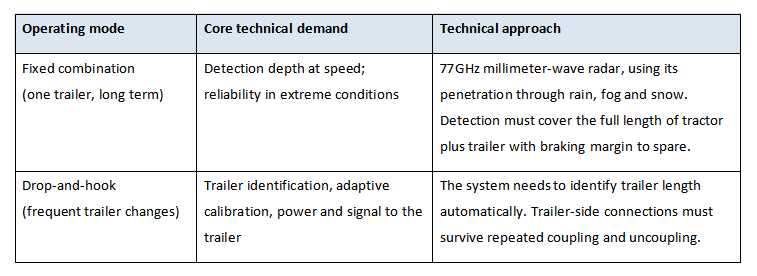
Conversely: if your fleet runs fixed combinations, one tractor tied to one trailer over the long term, you do not need to carry the calibration complexity described above.
In a fixed combination the failure risk does not sit in trailer swaps. It sits elsewhere — brackets loosening under long-term vibration, cable sheathing wearing through, sensors drifting out of position. None of these are solved by self-calibration. They are solved by installation practice and periodic inspection. Spending heavily on adaptive capability you will never use is money better put into brackets and harness.
Skip the brochure. Ask these three, all of which point at how the operation actually runs rather than at a specification table:
Question 1: How does your system sense the articulation angle?
Through a physical angle sensor, or through motion compensation in the radar algorithm? The answer decides how accurate the warning is in a bend. A supplier who cannot answer this has probably never done a semi-trailer project.
Question 2: After fitting a trailer of a different length, does the system need manual recalibration?
If it does, every trailer swap becomes a scheduled stoppage, and part of the efficiency gain of drop-and-hook disappears. The answer also decides whether drivers trust the system — and whether drivers trust it decides whether it is still switched on.
Question 3: Where do the trailer-side sensors get their power and signal?
Couple and uncouple, again and again — how long does that connection last? This is the question most likely to surface in year two, and the one most often skipped at the purchasing stage.
In commercial vehicle safety, doing half the job usually means losing the whole of it. On a semi-trailer, protecting the tractor is only the start. The return comes from the system holding up through every bend and every trailer change.
If the system is switched off because it false-alarmed or failed, the investment is worth nothing. Safety spending should be measured on whether it stays usable for the life of the vehicle and whether it fits the duty cycle — not on unit price alone.
That said, not every fleet needs the most elaborate configuration available. Fixed combinations have one correct answer, drop-and-hook has another. Working out which one you are before you spend is more effective than buying the most expensive option on the list.
November 2026 | CISBO, Shenzhen,China— 23-year professional manufacturer of commercial vehicle safety systems, IATF 16949 certified | www.szcisbo.com
Shenzhen CISBO Technology Co., Ltd. specializes in automotive electronic products including BSD, PWAS, AI monitoring, parking sensors, and rear view systems. With 23 years of experience and global certifications, we deliver high-quality solutions for safer driving. Explore our products and services today.
6F, Building 3, Lijincheng Industry Park, Gongye East Road, Longhua, Longhua New District, Shenzhen, 518109, China
Copyright © 2026 Shenzhen CISBO Technology Co., LTD. All rights reserved. Privacy Policy 粤ICP备:05005734号